
Betreuer/in: Sommer
The sustainable transformation of urban spaces requires spatially precise indicators such as the degree of land sealing and solar potential; however, collecting this data manually is hardly scalable. Existing AI methods typically fail in practice due to high annotation requirements or a lack of physical relevance for real-world applications.
Building on this, the present study investigates which segmentation architecture is best suited for fine-grained classification of urban areas when training data is severely limited, and how accurately pixel-based predictions can be translated into spatial indicators at the parcel level. To this end, an end-to-end pipeline is developed that automatically converts 20-cm aerial images (DOP20) and supplementary elevation and 3D geodata into urban ecological metrics and solar potential, evaluated on a custom-created 15-class dataset for Middle Franconia. A preliminary architecture search on the FLAIR proxy dataset shows that a selfsupervised pre-trained foundation model (DINOv3) with a lightweight SegFormer decoder outperforms supervised CNN and Transformer baselines and achieves over 80 % of its saturation performance with just 75 training images. When applied to the Bavarian dataset, the pixel metric remains moderate (mIoU: 49.89 %); however, the key point is that these local errors largely cancel each other out during aggregation at the parcel level: Ratio-based indicators such as the runoff coefficient (MAE: 0.0215) and unused solar potential (nMAE: 5.12 %) are consistently derived, while quasi-binary metrics remain more sensitive. These values demonstrate low error propagation but do not replace validation against real measurement data. This study thus demonstrates that foundation models drastically reduce the annotation effort and that the practical suitability of such methods is measured not by pixel metrics but by the accuracy of the derived indicators. The developed framework does not replace field surveys but serves as a resource-efficient tool for pre-qualification.
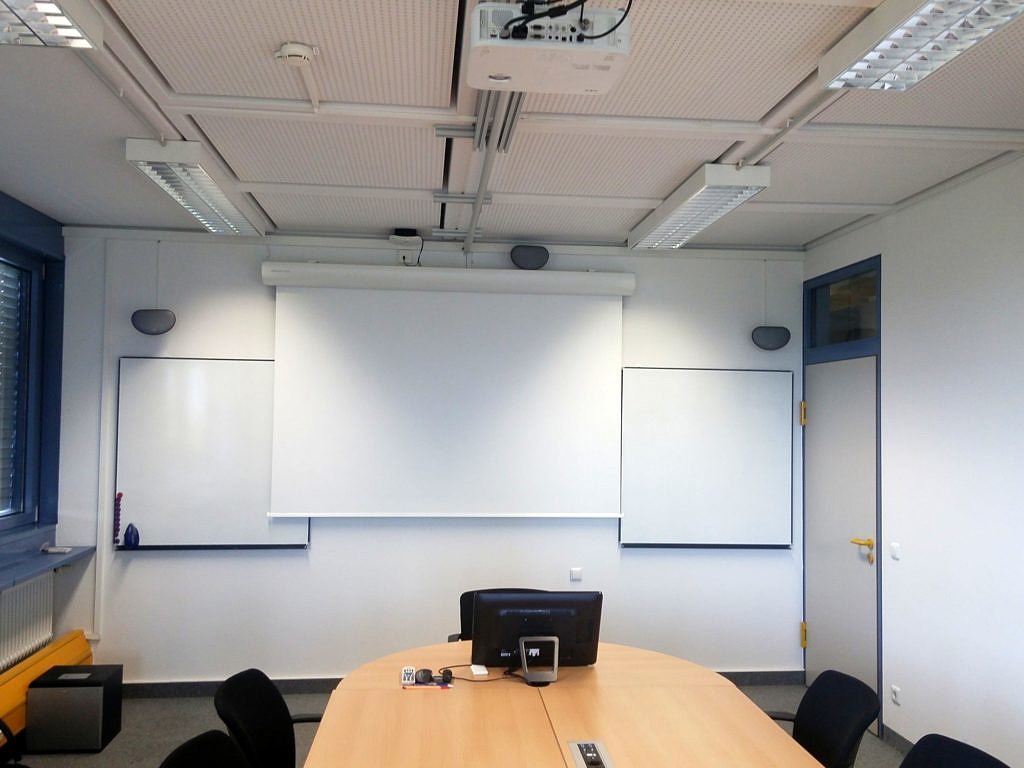
Room 04.137, Martensstr. 3, Erlangen
or
Zoom-Meeting:
https://fau.zoom-x.de/j/68350702053?pwd=UkF3aXY0QUdjeSsyR0tyRWtLQ0hYUT09
Meeting-ID: 683 5070 2053
Kenncode: 647333