
Winter Semester 2026/2027
Welcome to the event
Simulation and Modeling I
The course begins with an introduction to the field of simulation. Topics covered include discrete modeling, input modeling, random number generation, and output analysis.
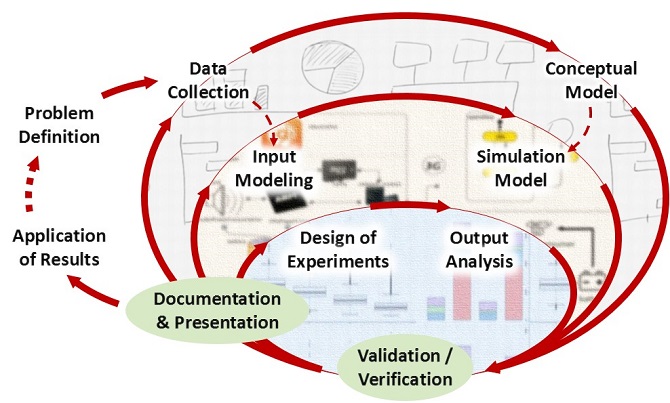
In addition, modeling paradigms such as event- and process-oriented modeling and Petri nets are covered. Simulation and AI round out the course. Hands-on exercises provide students with their first experience with modeling and various simulation tools.
Details (preliminary)
| Kind of event | Lecture (2 SWS) + Exercises (2 SWS) |
| ECTS Credits | 2,5 + 2,5 |
| Language | English |
| Lecture | Thursday, 10:15 – 11:45, Room 11501.04.023 (04.023 Hörsaal) Lecturer: Prof. German Link to campo / Link to StudOn |
| Submission| Exercises | Monday, 10:00 – 12:00 und 12:00 – 14:00, Raum 0.157-115 CIP Pool EEI campo First appointment: expected 26. Oktober. |
| Theorie | Support Exercises | Donnerstag, 12:00 – 14:00 und 14:00 – 16:00, Raum 0.157-115 CIP Pool EEI campo First appointment: expected 22. Oktober Link to campo / Link to StudOn |
| Lecturers | Dr. Anna Baron / Jonathan Fellerer, M.Sc. / Timm Bugla |
In case of any questions, contact sam1@i7.informatik.uni-erlangen.de
Overview of the various kinds of simulation, discrete simulation (computational concepts, simulation of queuing systems, simulation in Java, professional simulation tools), required probability concepts and statistics, modeling paradigms (e.g., event/process-oriented, queuing systems, Petri nets, UML statecharts), input modeling (selecting input probability distributions), random number generation (linear congruential generators and variants, generating random variates), output analysis (warm-up period detection, independent replications, result presentation), continuous and hybrid simulation (differential equations, numerical solution, hybrid statecharts), simulation software, case studies, parallel and distributed simulation.
The exercise is optional. You can earn bonus points for the exam. It will be a mixture of practical simulation tasks (as homework / with support during the exercise) and interactive theoretical exercise sessions.
Contents include: Calculation of expected values with the aid of probability theory, determination of confidence intervals, creation of simulation models using AnyLogic, hybrid modeling with statecharts, data collection and distribution fitting.
The exercises will be held on Mondays and serve for practice of theory, usage of various tools, and for preparation of assignments. It will also have some exercise with interactive solving of theoretical tasks.
When questions arise, please use the message board in StudOn. Personal questions can be asked at sam1@i7.informatik.uni-erlangen.de.
Law, Kelton: “Simulation Modeling and Analysis.” 5rd edition, McGraw Hill, 2014.
AnyLogic in 3 Days (free tutorial book)
Last update: 2026-09-15 – 15:17